Monday, May 15, 2006

Science is relative

I once asked a friend of mine who built large industrial chimneys in Melbourne what his main task was. He told me it was to make sure they didn't fall over. I guess this depends on engineering theory and mathematical computations. But does it depend too on social attitudes?

The West Australian Science Curriculum states:

'People from different backgrounds and cultures have different ways of experiencing and interpreting their environment, so there is a diversity of world views associated with science and scientific knowledge which should be welcomed, valued and respected. They [students] recognise that aspects of scientific knowledge are constructed from a particular gender or cultural perspective.'

Thanks to Kevin Donnelly in The Australian for this gem. Donnelly also points out that the South Australian Curriculum states that 'Every culture has its own ways of thinking and its own world views to inform its science' while the Northern Territory Science Curriculum speaks of a 'social-constructivist perspective' where 'science as a way of knowing is constructed in a socio-cultural context'.

Problems in the WA English Curriculum with its 'outcomes-based' ethos have been discussed before on this blog. Donnelly's comments above, and the recent disclosure that many General Practitioners don't know basic anatomy, suggests the sciences are not being exempted from this same scholastic propensity towards gobbledegook.

Nuclear leasing

Acting PM Mark Vaile called on Australians to keep an open mind on the issue of 'nuclear leasing'. This would enable the sale of uranium to countries which have not signed the nuclear Non-Proliferation Treaty provided they use the uranium for power plants and return spent nuclear fuel. A fillip to the Australian mining industry because it could then sell uranium to countries such as India which have not signed the NPT, a way of assisting globally to reduce greenhouse gas emissions and of reducing holdings of spent fue;l which could be used for nuclear weapons. But I am very skeptical of the ability of Australians to have a civil non-hysterical debate about this issue. As The Australian's editorial remarks:
'...Mr Vaile seems to have forgotten the way state and territory governments went into histrionics, when they were not hysterical, over Canberra's call a few years back for one of them to bury the tiny amounts of nuclear waste produced by Australia's only atomic installation, the research reactor at Lucas Heights. It will take a great deal of talk before the new idea of taking back for safe storage the residue of uranium we have exported gets a fair hearing'.

Nuclear power is a reality and a major new international source of electrical energy. The debate about whether it will be used is irrelevant. It will be used. The issue is to ensure it is used safely both from an environmental perspective and to keep this material out of the hands of terrorists. The idea of leasing - and more generally of storing spent fuel safely in Australia, is worth addressing.

There are difficulties with this proposal - it is part of George Bush's Global Nuclear Energy Partnership - but it should not be rejected out-of-hand. My fear is that interest groups in Australia will seek to turn discussion of this issue into an attempt to bury the Coalition. If smart politicians like John Howard sense this the debate won't even occur. Howard will not seek to develop policy initiatives that he knows won't be implemented even if the reasons behind non-adoption make no sense. This failure to consider options would be a pity.

Sunday, May 14, 2006

Sins of John Howard

The Sunday Age points out in an article and in an accompanying editorial just what is wrong with John Howard.

Well, Howard never personalizes things and never insults people and this has had a devastating effect on ‘public debate, once so volatile and imbued with invective and now so seemingly narrow’. In fact Howard uses ‘the national interest’ as a foil rather than ‘his personality or aura’. It is disgraceful.

The editorial points approvingly at how Paul Keating drove the national debate into unpopular areas such as cultural policy and the (rejected) republic. He also did a fair bit for inflation, public debt and unemployment. I was always grateful to Paul for helping me to understand my cultural identity. But for all their faults I am confident the Australia Labor Party can provide lots more vision and it has capabilities in personalizing debate and insulting people. A veritable conga line of invectiveness?

My question though. Where does one buy a decent Sunday newspaper in Melbourne? I haven’t seen one for years.

Update: I was tacked in the comments section below over my claim that giving the RBA monetary independence had been a major achievement of the Howard Government. Alan Wood in 'The Goldern Years' (in N Cater (ed) , The Howard Factor) supports my contention and sees the change as significant. At a press conference in 1995 Peter Costello said:

'...that monetary policy would be the responsibility of the RTeserve Bank and there won't be any sort of midnight calls or pressure or boasting, as you've got from Mr Keating on how he pulls the levers'....

Alan Wood goes on to remark:

'This was a watershed in the conduct of monetary policy bin Australia. It formally gave the RBA policy independence and ended the practise of consulting the government of the day before making interest rate changes...'

'This independence has been particularly important...For the politician (low) interest rates are the target, which is precisely why central banks need independence'. (page 74)

Saturday, May 13, 2006

We don't know what we want

An attractive, intelligible modern economics publication is the Journal of Economic Behavior and Organisation. In two recent successive issues it has articles, Tom Sawyer and the Construction of Value (Dan Ariely, George Loewenstein & Drazen Prelec) and Honestly, why are you driving a BMW? (O. Johansson-Stenman & P. Martinsson) both of which focus on consumer tastes. These are the things that economists typically take as ‘given’ to consumers or mechanically molded by marketing.

Do we know what we like or dislike? The Tom Sawyer piece starts with the famous passage from Mark Twain’s novel Tom Sawyer where Tom has the unpleasant task of having to whitewash his aunt’s fence. Tom pretends that the task is a joy and finally gets his friends to pay him to help complete the chore. And those who do the work enjoy it! This suggests that it is not self-evident that - even a familiar activity - is pleasant or unpleasant to an individual. It is not clear that people will reliably know what they like so valuations of goods and experiences have an arbitrary component. The arbitrariness is large enough so that it cannot be assumed that voluntary trades in markets will increase individual advantage.

This is obviously true for socially obnoxious products such as cigarette products but might be also true for more ordinary goods and services as well. People might not have a pre-existing dollar value on ordinary goods and services and, indeed, might not even have a preexisting sense of whether an experience is good or bad. ‘Tom’s Law’ suggests they don’t. The paper discussed advances the proposition, based on some experiments, that experiences can be manipulated by non-normative cues such as whether agents pay to do something or have to be paid to do it. If you have to pay for it you tend (like Tom’s friends) to value it more positively. Moreover, in repeated trials people's judgments are seen to be consistent in the sense that those who were initially paid had to be paid more to gain more of the experience or, if they paid, they would pay more to consume more. An econometrician observing this behavior would assume consumers obeying the a 'law of demand' (that purchases vary negatively with price) even if people couldn’t really judge if experiences were good or bad.

Thus one gets orderly choices with systematic demand behavior even though people cannot sensibly value things. The orderly demand behavior stems from the fact that people try to not violate obvious laws of consistency but are anchored by their initial views of things. But this buries standard economic notions of how, in a market economy, preferences interact with technologies to determine what prices and outputs prevail. Now preferences might reflect the posted price of an item via an anchoring effect. Prices can prevail because of collective anchoring and accidents so that – even without market failure – free consumption choices by fully informed individuals need not maximize welfare.

We worry about our self-image. The second paper cited also proposes that people do not know their own preferences accurately and in fact need to ‘construct’ them. They do this by attaching pleasure not only to things consumed but also from the image they project to others and their self-image. People falsify their own sense of preference to obtain social acceptance and to promote their own self-image. They deceive themselves by understating the extent to which they seek the approval of others (to admit this would be to admit a nasty) – advancing self-image - and by exaggerating their signals of social responsibility promote their presentation to others.

Some of these ideas are well-known – work on positional goods that convey impressions of wealthy, competence and ability, suggests that visible goods like BMWs convey a lot of relative status value. And advertisements even appeal to self-worth - 'treat yourself - you deserve it' is a standard line. Also the warm glow effect in contingent valuation of environmental assets (using people's stated preferences to infer how they value non-marketed items) suggests people falsely over-value the environment to 'appear good'.

In a survey on car purchasing decisions the authors confirm these ideas. They find that most people consider their own concern for status when purchasing to be minor in comparison with the status concerns of others. Similarly, most individuals considered themselves to be more environmentally concerned than other people. People will therefore give the impression, in conversation, that they are much more environmentally concerned than they are. These results are consistent with an extension of the conventional theory where an individual's self-image is added to the considerations that operate when they make a purchasing decision.

These papers make me doubt basic economics ideas. They intensify my impatience with those who argue that smokers, problem gamblers and drug addicts should be left alone, to their vices, on the grounds that they are rationally maximizing their utility.

Friday, May 12, 2006

High speed public internet plans

I have criticised on this blog (here, here) the quality of Australia's broadband internet service. I aired these views to a group of economics students before the budget. One student said - given the regulatory complications why not get the public sector to lay out a high speed network and retail broadband services to various businesses including Telstra.

This appeals to me as I believe the partial privatisation of Telstra was an error and that the complete privatisation will compound this error. If getting the government to repurchase stock in Telstra to republicise it is 'fantasy land; stuff (I am one of its few supporters) then the proposal advanced by this student makes sense. Otherwise there is a difficult compromise with Telstra trying to maximise its share price and the Government trying to limit Telstra's inefficiently overpriced, monopoly provision of access to a vital national asset.

Indeed Kim Beazley's budget response proposal to publicly-provide a high speed broadband internet service is consistent with this. The numbers Beazley quotes still suggest a substantial private involvement - the costs are much larger than the numbers he provides - but the gist of his idea is sound.

Australia is a large country where transport and communication are binding constraints on development. Regional development schemes often involve 'picking winners' and 'pork-barrelling' at election time. If governments do seek to promote regional development (and I think they should) then a high speed communications network would complement investment in improved roads. Then firms could take advantage of such improved communications on the basis of market opportunities rather than political plans.

Improved communications and entertainment possibilities would encourage young people to continue living in regional Australia and facilitate distance education and other training options. A good idea.

Flagging fortunes

Salon asks whether sexually demanding women cause impotence? This evaluates an argument in the Washington Post. The Salon thesis is that consumption of alcohol, cigarettes, drugs etc, as well as female assertiveness, take a toll on male potency. The basic issue: To what extent do men only enjoy sex if they see it as a winning move in a competition?

'a sexual economy where female desire is allowed to match male desire could lead to a changed playing field on which the boys were less motivated by the sense that sex is the equivalent of a touchdown, scored by pushing your way through the opposing team's defense'.
So, for women
'Why don't we just buckle up our chastity belts and give those boys something to focus on unlocking already? Because lord knows, our eager, aroused bodies are totally harshing their hard-ons!
I envy men in a happy world where such fantasies are true. I don't believe them. Pursuit is interesting (and involves effort) but the action and outcome are of prime importance.

Thursday, May 11, 2006

Bank dicks

At the International Consumer Credit Card Summit 2006 yesterday representatives of the major Australian banks warned of the fearful consequences of low interest rate credit cards in Australia. Ms. Jenny Fagg, Managing Director Consumer Finance of the ANZ, warned, in this morning’s AFR (subscription required), that competing low-rate credit card segments ‘can’t make money’. The ANZ Rewards and Frequent Flyer Visa Cards prevent such difficulties by charging 18.75% interest on loans while the interest paid on a Progress Saver Account is 3.51%.

The margin here will be justified (with academic hack support) because the banks do almost no checks on credit ratings so the interest rates must reflect expected default rates. They capture both good and bad borrowers and charge high rates so that the good borrowers cross subsidise the losses of the bad.

Well why not do a credit check on customers that customers themselves are offered the chance to pay for? Why not the following deal? The banks will provide credit card loans at the deposit rate plus 2% (a healthy profit margin) if a customer agrees to provide security covering the limits on such a card at the customer’s own expense. So the customer provides a mortgage on assets (his or her home or other assets) as they would with a normal personal loan or overdraft, then pay interest of 5.51% on debt but agree to cover all costs of arranging such security including costs associated with debt recovery should they default.

I don’t believe the Australian banks would offer such a deal because the high margins on credit card debt are a major determinant of their profitability. The margins in fact are much greater than those required to cover default costs - they are large eenough to suggest the banks are inefficient oligopolists who, apart from offering poor customer service, provide uncompetitive access to credit. They inhibit economic growth, the efficiency of capital markets and they unfairly penalise ordinary working Australians.

And the best the banks can offer is the pathetic argument that the high rates they charge are saving other financial institutions from losses and borrowers from bankruptcy. And don’t tell me about the special rates of 9-11% they offer ‘approved’ customers. These too are excessive. And personal loans at lower interest rates (still with high bank margins built in) do not have the negotiability and convenience of credit cards as sources of short-term debt.


Three cheers for the full gale force of competition. Its already at hurricane intensity - Australians acquired nearly 1 million new credit cards in the first 3 months of this year - and most of these would be switches away from the high interest cost cards offered by major banks to more commercially reasonable alternatives.

Competing free 'scholarly search' engines

A competitor to Google Scholar has arrived on the scene with the beta version of Microsoft Scholar which has a few million articles in computer science, electrical engineering and physics with some economics material.

A blogsite by a librarian, Dean Guistini reviews the alternatives here. While similar in broad approach, MS has a split pane - allowing your mouse to hover over a selection on the left hand list of references gives more information about that entry in the right pane which is useful.

GS has far richer search capabilities in the economics area. I searched a few items as a trial and, for example, ‘public goods’ got 494,000 responses using GS and 8,490 using MS. But MS is rumoured to be planning to index all Elsevier journals which might change things.

Competition between ‘open access’ software is hotting up and teachers and researchers will be winners from this. Along with free or low cost provision of research information online this helps to resolve increasing costs of published scientific journals. The role of librarians such as Paul Haschak in this activity is noteworthy. Open Access News reviews material in this area.

Wednesday, May 10, 2006

Andy Warhol looks a scream


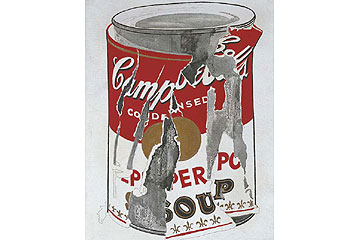
The New York Times reports a $143 million dollar sale of modern art including the $11.7 million dollar sale of Andy Warhol's 'Small Torn Campbell's Soup Can (Pepper Pot)'. It seem's a trite expensive but Andy is FAMOUS.

I always enjoyed Andy Warhol's artwork - particularly his Elvis and Marilyn prints - and have collected books of such. I also enjoyed his foolish philosophy text 'From A to B and Back Again'. 'Wasted space is any space that has art in it' was a favourite line. I also appreciated 'The psychiatrist never called back' and 'What do I do on Saturday when my philosophy runs out'.

Mid-week review

An uneventful Wednesday for me - with two return trips from the suburbs to the City and teaching both early morning and late evening (the last was enjoyable). There was not a lot that particularly sparked my consciousness. I searched around the blogs for views on the Commonwealth Budget mid-morning and assume from the paucity of leftist grizzles that it has been quite well-received. My main complaint remains that it does not address what I believe to be a serious resource problems in the Australian universities - but as a participant many will assume this is self-interest talking.

I have a wise uncle who once told me that he was determined to do something really enjoyable every day of his life. Normally I seek to follow his maxim - even if it is only drinking some good wine. But finishing at 9-00 pm this evening the best I could manage was a wood-fired pizza at Woodfire in Ivanhoe (it has had good reviews see here and here). After that I have been listening to a borrowed copy of Phillip Glass' opera satyagraha which I have grown to enjoy but it is very driven and frenetic. And to be honest I am a bit out of it - this sort of music is for when you want to get your blood up!

I hope you enjoyed your day and - as usual - welcome your views, here, on your day, the world or anything else.

Tuesday, May 09, 2006

Budget facts

The full Commonwealth Budget Papers are at www.budget.gov.au.

The following is my summary of tonight' s Budget Brief.

In short there are significant tax cuts, improvements in benefits to retirees, significant inducements for firms to invest in new technology through enhanced superannuation benefits, furthering of the trend to tax family rather than individual incomes, a bit more on health research but not much more for education in general, big increased spending on defence, roads and mental health and a bit on the Murray Darling River System.

One issue is the implied effects of running an expansionary budget on interest rates. This effectively means that the RBA has been left with the exclusive job of maintaining internal balance and of preventing the economy from overheating. With high international capital mobility this is, anyway, the desired assignment of stabilisation duties in a small open economy like Australia. A future easing of commodity prices would then be met by a devaluation of the Australian dollar rather than through fiscal spending cuts.

1. Fiscal Outlook

1.1 Budget provides for cash surplus of $10.8b, the Government’s 9th surplus.
1.2 Net debt eliminated providing interest savings of $8b a year which can be invested in physical and intellectual infrastructure.

Comment: The notion that having low debt makes sense for a Government facing 'population aging' issues is sensible. But there is nothing intrinsically undesirable about spreading the cost of major capital works programs or of investing in science and education across generations by using debt. Debt phobic attitudes can be counterproductive.

2. Economic Outlook

2.1 Economic prospects good with growth forecast to be 3.25% in 2006-07.
2.2 Business investment to grow strongly over 2006-07 and export growth to pick up.

Comment: These forecasts assume that commodity prices remain strong in the immediate future and this is a reasonable assumption.

3. Personal tax cuts

3.1 Personal tax cuts worth $36.7b over 4 years from 1 July 2006.
3.2 The 30% threshold will rise to $25,001.
3.3 The 42% marginal tax cut to 40% and threshold rises to $75,001.
3.4 The 47% marginal tax cut to 45% and threshold rises to $150,001.
3.5 Low income tax offset increases to $600 per year and phase out from $25,000, up from $21,600.
3.6 Fringe benefits tax cut to 46.5%.

Comment: The tax cuts are significant given the considerable cuts in previous budgets and the prospect of further cuts in an election year budget next year. As one of the higher-income people who will get most benefits from these cuts my preference would have been to invest the money in education. I think the long-term economic benefits of investing in our universities would have offered greater social returns.

4. Plan to simplify and streamline superannuation

4.1 Tax free superannuation benefits for people aged 60 and over paid from a taxed fund.
4.2 Abolishing reasonable benefit limits (RBLs).
4.3 Streamlining the contribution and payment rules.
4.4 Reducing the pension assets test taper rate from $3.00 to $1.50 for every $1,000 of assets.

Comment: The most dramatic changes in the budget. According to the AFR (11/5/06, p. 7) a retirees with a lump sum of $200,000 will be $10,287 better off while one with a weekly benefit of $1,000 will be $170 better off. Huge changes. Good for me as I retire in the next 10 years and my super will be tax free. Note that this move reduces public savings because tax expenditures on superannuation will grow. Time to rethink retirement strategies - there are both income and price effects of this change - I get a better after-tax return but need to save less.

Note that Paul Keating in the Australian argues that under the old superannuation system one has incentives to take superannuation benefits as annuity income rather than a lump-sum. The reason was that RBLs - the maximum amount of retirement and termination of employment benefits that you can receive over your lifetime at concessional tax rates - was doubled if at least half the accumulation was taken in the form of an annuity. If you elected to take the accumulation as a lump sum you would enjoy the tax benefit on only half the RBL that an annuity would attract.

Now RBLs are abolished there is no incentive to take superannuation as a lump sum. Keating sees this as potentially disadvantageous since people aged close to 60 with perhaps 30 years of life ahead of them will now have incentives to spend up big, exhaust their savings and then go on an old age pension. It seems to me Keating’s argument is consistent with the philosophy that motivated forced savings via superannuation in the first place – that (i) with a publicly-funded pension scheme and (ii) because of agent myopia, people will under-save for their retirement. If this is true at pre-retirement ages it must be also be so when retirement approaches.

This will increase the burden that pensions impose as the population ages.

5. Enhancing incentives for business

5.1 $3.7b over 4 years to lift the diminishing value rate for depreciation from 150 to 200% for newly acquired eligible assets, supporting take-up of new technology.
5.2 Taxes on small business cut by $435m over 4 years
5.3 Reduce compliance costs for small business and increase access to small business tax relief arrangements and CGT concessions.

Comment: The major concession to business in the budget. Brings Australia into line with other OECD countries. On balance a pretty good idea. It should hasten the development of large priivate capital works programs - building ports and new mine processing units in the minerals sector.

6. Supporting families, older Australians and carers

6.1 Eligibility for the maximum rate of Family Tax Benefit Part A extended to families with an annual income of up to $40,000 (currently $33,361).
6.2 Large Family Supplement of $248 a year extended to eligible families with 3 children.
6.3 A one-off payment of $102.80 by 30 June 2006 to each household eligible for the Utilities Allowance and to each self-funded retiree eligible for the Seniors Concession Allowance.
6.4 Eligibility for the Utilities Allowance and the one-off payment extended to Mature Age Allowance, Partner Allowance and Widow Allowance recipients.
6.5 A $1,000 one-off payment to recipients of the Carer Payment and a $600 one-off payment to recipients of the Carer Allowance by 30 June 2006.

Comment: Increases the propensity to tax the family unit rather than individual incomes. The one-off payments and utility deductions don't make much economic sense - perhaps they are a response to what are assumed to be transitionally high petrol prices.

The main planned help for families lies in letting the market determine the supply of childcare places rather than restricting subidies to a predefined group. This might be slow to take effect if there are delays in training new childcare workers but seems a sensible move.

7. Furthering health and medical research effort

7.1 $735m in additional funding over 5 years for medical research.
7.2 $170m to establish a new health and medical research fellowship scheme.

Comment: Tinkering and confined to the medical research sector. Why this specific sector? Why not push hard to accelerate investment in human capital Australia-wide? There is a skills shortage that needs to be addressed via increased investment in training.

8. Strengthening defence

8.1 $10.7b between 2011-12 and 2015-16, providing a firm basis for continued long-term Australian Defence Force planning and enhanced capabilities.
8.2 $2.2b to acquire new C-17 aircraft to enhance significantly the Australian Defence Force’s airlift capability.
8.3 $1.5b to increase the Army’s size and enhance the Army’s operational readiness.
8.4 $1.5b to 2009-10 to strengthen intelligence services, airport and air transport security, and regional cooperation.

Comment: Significant and building on earlier budgets which also increased our defence capacity. Sensible given problems with terrorism.

9. Investing in road, rail and water infrastructure

9.1 $2.3b in road and rail infrastructure funding including to upgrade earlier key sections of the Hume ($800m), Bruce ($220m) and Pacific ($160m) highways.
9.2 $561m for upgrades to other major highways.
9.3 $308m for the Roads to Recovery programme.
9.4 $270m to improve rail track quality on the North-South rail corridor.
9.5 $500m for improved water management in the Murray-Darling Basin.

Comment: Regional handouts that should sure up support for the government. No spending on improving port facilities which are subject to bottlenecks. The MDB expenditure a good idea. Now a commitment to high-speed internet in regional areas to connect the country - cheaper than building roads!

10. Investing in health and improved service delivery

Funding boost to mental health system of $1.9b over 5 years, including $538m to improve access to GPs, psychiatrists and psychologists under Medicare.

Comment: Not a lot to say but I might need the help myself given the difficulties on maintaining a family and running a blogsite.

I’ll add views, links and commentary to this as I digest other views - without, in this case, necessarily indicating the changes.

Talking to Iran

I am puzzled as to why the US is so quick to reject even considering the letter from President Mahmoud Ahmadinejad of Iran and why there are not moves to initiate a dialogue with Iran. I am no supporter of Mad Mahmoud but doesn't refusing to even dialogue with him give MM the initiative. We tried to talk to the Americans but.....

I agree with Kevin Drum:
Iran has elected a wingnut president, they've made progress on nuclear enrichment, gained considerable influence in Iraq, and increased their global economic leverage as oil supplies have gotten tighter. So why blow another chance? If the talks fail, then they fail. But what possible reason can there be to refuse to even discuss things with Iran — unless you're trying to leave no alternative to war?

Monday, May 08, 2006

Taxing working mothers

One of the oldest arguments for child-care subsidies is that the imputed value of the work provided by mothers within households is untaxed so working mothers should be given a break using childcare subsidies. Now the argument has resurfaced in a different guise in a paper by Patricia Apps, Family Taxation: An unfair and inefficient system. The paper is reviewed by John Head in the Australian Financial Review today (subscription required) . Head supports App's views.

The gist of the argument is that the family tax benefit effectively amounts to taxing total family income rather than individual income. To Apps this means working women are unfairly overtaxed. As a consequence their workforce participation rate is only 75% that of men and their hours worked only 50% of male hours for those under 65. The Apps-Head target is to get far more women working and for far longer hours. Getting more women into the workforce, to Head, would 'draw heavily on the reserve army of unemployed women'. Indeed the present tax and welfare system is savagely discriminatory against working mothers and threatens economic disaster for the country'. (my bolding, phew!)

I disagree with Apps and with Head and think John Howard's family-based tax policies are essentially sound because they are pro-children. Apps and Head assume that children are best brought up in paid child-care rather than by one of the parents. This is why they favour taxing individual incomes and heavily subsidising child-care. The policy of taxing joint family income provides incentives for couples to take care of their own children and this is a sound idea. The parent who works need not be the male but at least one parent remains at home for much of the time to bring up young children.

Moreover, I cannot see that it is reasonable to associate welfare gains with having everyone in the workforce and assigning all child-care duties to paid professionals. This is placing too much emphasis on our economic functions as producers and insufficient emphasis on our role as child-raisers. Its a backward way of looking at families that has been fostered by bigoted feminism and which demeans the role of families and parenting.

Around the blogs

Good blog postings on teaching economics, peak oil, health systems and global warming.

Teaching economics. From NewEconomist comes advice that R. Preston McAfee’s text Introduction to Economic Analysis has been published online. It looks excellent – full of good theory and lots of punchy examples. By the way Ariel Rubinstein has put together his online notes on price theory here – an excellent set of fairly advanced notes for about a 10 lecture course. This is really good – it doesn’t flood a beginner graduate student with excessive detail – but captures major ideas and the idea of proving propositions.

Peal oil. From Oikos I learn that the excellent recent Economist article (subscription only) on ‘peak oil’ has been published at the Ecological Economics blogsite. Other good articles here and a good blogsite here. The original ASPO (Association for Study of Peal Oil and Gas) site is here. A 2004 paper by Morris Adelman (one of the real experts in world petroleum markets) ‘The Real Oil Problem’ is here. A critique of Adelman is here.

Public health. Finally from Beat the Press I got this excellent discussion (along with hyperlinks) of the New York Times critique of the British Health Care system.

Global warming. Courtesy of Andrew Leigh an informative qualitative discussion (by two quantitative modellers) of how we can think about global warming in a way that accounts for uncertainty is here.


Note: Unlike my other posts I will add to or edit this post without explicit notice.

Wikipedia online economics

John Quiggin is helping to assemble contributors to provide a Wikipedia coverage that includes all the major categories in the Journal of Economic Literature (JEL) economics subject classification system. His hope is that the scheme is robust enough to allow for an expansion of Wikipedia to compete with specialist works like the New Palgrave Dictionary of Economics. John is optimistic about Wikipedia’s potential but, as he notes, the economics section of Wikipedia is a long way from being a comprehensive reference source at present. Currently there are whole categories in the JEL system for which Wikipedia doesn’t have an entry - John cites the example of Computable General Equilibrium models for example.

I use Wikipedia all the time so I support this effort. One advantage of Wikipedia is its currency. The day after noted economist, John Kenneth Galbraith's recent death, his entry on Wikipedia had been updated to reflect that fact. Articles in the New Palgrave will take years to edit and publish. In fact ex-Agenda editor Michael James is now editing a second edition of the New Palgrave due for release in 2008. The earlier edition was released in 1987 so it will be more than a 20 year gap. Other advantages of the Wikipedia approach are that (i) it is free, (ii) entries can be classified and accessed via a subject classification system such as JEL and (iii) hyperlinks can be introduced in a Wikipedia entry that connect to related information very quickly. Thus – the supreme virtue of the Web occurs - search can be carried out immediately online at low cost.

The New Palgrave will be an expensive volume but online access will be available to subscribers so in this sense it too will be easy to search. One issue will be how much its publishers do invest in updating information and whether, in fact, updating occurs at all. A difficulty with making updates is that citation becomes difficult.

Obviously we benefit as consumers and producers of economics in having this form of competition between conventionally published and open source information. Wikipedia will have some competitive advantages but so too will the New Palgrave. Citation will be easier from the New Palgrave and accuracy and comprehensiveness will be claimed to be an advantage. Authors will be identified and paid for their contributions so one would expect better quality. I know that 'open source' enthusiasts argue that intellectual motivation can offset this last factor but I remain sceptical. On the issue of accuracy a recent debate has concerned the relative accuracy of Wikipedia compared to such publications as the Encyclopedia Britannica. The evidence suggests Wikipedia does as well or better. Frankly this evidence surprises me but, despite some problems with Wikipedia, it is obviously a valuable resource. Other work has compared operating systems such as the commercial Windows system with the open source Linux system. From many viewpoints Linux comes up surprisingly well in this comparison.

I'll probably offer my own services to John Quiggin’s effort and certainly applaud his enthusiasm for the Wikipedia project. I’ll also certainly buy a copy of the New Palgrave when it comes out. I bought the 1997 edition and it is one of the most used sets of books in my professional library.

Class warriers show no class

Paul Austin in The Age this morning identifies the hypocrisy of the Labor Party's Rob Hulls in attacking about-to-become Victorian Liberal Leader Ted Baillieu as the 'toff from Toorak'. Of course it is no-one's fault if they happen to be borne rich - even Labor Politicians- but the hypocrisy of the Labor Party on this one is just breath-taking:

'Hulls' attack was comprehensive: he suggested Baillieu had inherited virtually everything he had in life, including his seat in Parliament and now the leadership of his party.

'Hulls' hypocrisy is shameless. In fact, Baillieu is coming to the leadership in a remarkably similar way to Steve Bracks, who won the job unopposed about six months out from an election after a long campaign by others of destabilisation of the incumbent (in Bracks' case it was John Brumby, in Baillieu's it is Doyle).

And if Hulls wants to talk about people "inheriting" seats in Parliament, what about multimillionaire businessman Evan Thornley, who was unable to win preselection in his own right but has now been hand-picked by the Premier to take a guaranteed seat?

Yes, Baillieu went to Melbourne Grammar. But so did Deputy Premier John Thwaites and Treasurer Brumby. Former Labor premier John Cain went to Scotch. Hulls himself had the privilege of being educated at Xavier College and Peninsula Grammar.

Baillieu lives in a million-dollar-plus house in the nice suburb of Hawthorn, with no driveway or swimming pool. Bracks lives in a million-dollar-plus house in the nice suburb of Williamstown, with driveway and swimming pool.

At least they live in their electorates — unlike nearly two-thirds of Bracks' cabinet. Hulls himself is one minister who lives outside his electorate. Police Minister Tim Holding is another. His electorate of Lyndhurst covers what might in class-warrior terms be called the working-class suburbs of Dandenong South, Noble Park and Springvale. But Holding lives in a million-dollar-plus house in the nice suburb of East Melbourne'.

Sunday, May 07, 2006

Meat-eating

The evidence just keeps on accumulating. Those nasty things we have been told for years about eating meat are often false. Quote:

‘REPLACING two or three slices of bread or a handful of pasta a day with a small serving of lean red meat may help people lower their blood pressure, Australian research suggests’.

This is great news but is something Robert Atkins (and many others) have been arguing for decades. A carbohydrate-restricted diet reduces blood pressure. ‘Nothing is more consistently or more rapidly observed than normalization of blood pressure’. New Diet Revolution.

When your GP tells you that your blood pressure is a bit up and you should watch your meat intake ask him or her for the evidence that this will help. It is not unambiguous.

National education certification

According to a DEST recommendation all Year 12 students in Australia will sit a national exam assessing their literacy, writing, numeracy and writing skills as part of an Australian Certificate of Education to replace all existing state qualifications in 3 years. To quote from the report:

'A widely held view among participants in our national consultations was that, regardless of where they live in Australia, students in the senior secondary school should have similar opportunities to engage with the fundamental knowledge, principles and ideas that make up school subjects. There was general agreement that students in different states and territories taking particular subjects—such as Economics or Biology—should be able to engage with those subjects in similar depth and with similar academic rigour. Some participants drew attention to disadvantages and inequities that could result from differential access to fundamental learning within a discipline.

We are recommending the identification of curriculum essentials: fundamental knowledge, principles and ideas that should be taught in a subject, regardless of jurisdiction. In the first instance, these essential curriculum elements would be developed for a number of nominated mathematics, English, science and social science/humanities subjects. They would spell out a core of common content to be taught in all states and territories, but would not determine the entire curriculum in a subject and so would not constitute a ‘national curriculum’.

We are recommending that a national ‘subject panel’ comprising subject matter and assessment specialists and members of the relevant professional subject association/ s be responsible for identifying essential curriculum content in a subject. This process should include some international benchmarking to ensure that curriculum content is consistent with international best practice in the senior years of school’.

This recommendation is supported both by the Education Minister Julie Bishop and (predictably) by the Opposition Spokeswoman on education Jenny Macklin.

Note the weasel words in this quote. Imposing uniform standards is giving 'similar opportunities' Allowing differences in curricula encourages 'inequities'. The proposal will eliminate ' 'inconsistencies’ between the states and to make education qualifications from different states comparable. The standard bureaucratic love of uniformity.

In my view the recommendation should be opposed. Even if a uniform curriculum is not imposed across the states, the idea of getting national ‘subject panels’ to determine what is ‘fundamental knowledge’ in a disciplinary area seems dangerous to me. That the process involves ‘international benchmarking’ to ensure that curricula are ‘consistent with international best practice’ makes me really fearful as I hear this latter nonsense all the time in the post-Dawkins universities. Apart from the offensive cultural cringe involved, it is unhelpful, except to bureaucrats for whom it provides potential for greater central control and regulation.

I am dissatisfied with aspects of high school curricula. But I do not favour heavy-handed centralist solutions. It is better that curricula be state and institution-based as far as possible with competition in providing education. The foolish 'outcomes-based', 'content free' Western Australian high school currulum should be publicly criticised and debated - centralisation leaves open the prospect that future national governments might impose such foolish curricula nationwide. As discussed last year, when Brendan Nelson floated the idea, Bob Carr correctly saw the move as an unnecessary Federal intrusion. Education thrives on ‘inconsistency’ and ‘non-uniformity’, Experimentation between competing approaches is essential. I do not believe employers face serious difficulties in evaluating students with different school backgrounds in Australia.

This is the sort of proposal I would have expected to come from the centralist gnomes of the Australian Labor Party in some bygone era. State Government's should strengthen their muted, cowardly opposition to this poor policy recommendation.


Saturday, May 06, 2006

Australia's high savings rate

The Reserve Bank of Australia’s recent claims regarding our savings habits are intriguing. Conventionally-defined household savings (disposable income less consumption less depreciation) has become negative in Australia in recent years – close to the lowest observed among countries like the US, Britain and Italy. However if savings is redefined to include both superannuation and the accumulation of stock market wealth, our savings rate has virtually doubled over the past few years and, at 24% of disposable income, is among the highest of any developed economy.

Moreover the RBA suggest that the increase in wealth is not an ephemeral phantom that reflects an illusory stock market boom since the increase in stock market prices is well-justified by increased company earnings. Note also the strong savings performance of the US in these same terms - it outforms even Australia. Presumably both economies are now revealled to have good potential to deal effectively with population aging issues. But why are both countries running such huge current account deficits – I thought these reflected inadequate savings - as Ben Bernanke states 'That inadequate U.S. national saving is the source of the current account deficit must be true at some level; indeed, the statement is almost a tautology'.

Update: Access Economics has criticised high levels of government spending as a $35 billion bet on an unending continuation of the commodities boom (Commonwealth Budget Monitor, #69). The implication is that all such booms come to an end so it is an unsound bet so government should be more prudent. But, if this is so, then is not the RBA also gambling on a continuation of the boom in claiming that Australia's savings rate is high? Even if equity prices have risen to reflect improved commodity prices, so P/E ratios are not high, the market will fall if commodity prices decline. Even if the current situation in the stock market does not correspond to a bubble, valuations can still be myopic. Then, if commodity prices do decline as the Treasurer says they will, households will experience capital losses and using the new measure, savings will fall.

There is a distinction between lodging savings in a bank and saving in the stock market because the latter is riskier and capital gains or losses are more important. To say that high capital gains offset increased foreign borrowing will not be true if capital gains on equity turn into losses. The distinction between old and new savings definitions hinges on the distinction between debt and equity contracts. This also means that the current account as a measure of our increasing indebtedness needs to be rethought.

moneybags blog

I have decided to separate out my thoughts on the crass business of making money on the stockmarket from the rest of my blog and now have a separate moneybags blog which lies at the top of the list of links to the right of this page. I'll develop some decent links to other sites there when I get a chance. I'll continue to comment on general macroeconomic issues here.

Again your comments and suggestions for ways of increasing wealth are welcome though they will now be there not here.

Friday, May 05, 2006

Expensive and ineffective health care

Paul Krugman writes an interesting op-ed on a US study suggesting that although Americans spend 40% more on health than do the British they are sicker. The study's conclusions are worth citing:

‘The US population in late middle age is less healthy than the equivalent British population for diabetes, hypertension, heart disease, myocardial infarction, stroke, lung disease, and cancer. Within each country, there exists a pronounced negative socioeconomic status (SES) gradient with self-reported disease so that health disparities are largest at the bottom of the education or income variants of the SES hierarchy. This conclusion is generally robust to control for a standard set of behavioral risk factors, including smoking, overweight, obesity, and alcohol drinking, which explain very little of these health differences. These differences between countries or across SES groups within each country are not due to biases in self-reported disease because biological markers of disease exhibit exactly the same patterns. To illustrate, among those aged 55 to 64 years, diabetes prevalence is twice as high in the US and only one fifth of this difference can be explained by a common set of risk factors. Similarly, among middle-aged adults, mean levels of C-reactive protein are 20% higher in the US compared with England and mean high-density lipoprotein cholesterol levels are 14% lower. These differences are not solely driven by the bottom of the SES distribution. In many diseases, the top of the SES distribution is less healthy in the US as well’.

Krugman suggests that the US has achieved a sort of 'inverse miracle': Americans spend much more per person on health care than any other nation – in 2004 about 16% of GDP, it is larger than the food production sector - yet it has lower life expectancy and higher infant mortality than Canada, Japan and most of Europe.

Why? A lack of universal health insurance is a factor in the poor health of lower-income Americans but almost all upper-income Americans have insurance and their health is often worse too. Another reason seems to be that US medicine is error prone. Bad habits are part of the story as Americans are more obese. But a statistical analysis suggests that bad habits don’t explain that much. One explanation lies in the excessive workloads and stress in US society:

‘Full-time American workers work, on average, about 46 weeks per year; full-time British, French and German workers work only 41 weeks a year. ….our workaholic economy is actually more destructive of the ‘family values’ we claim to honor than the European economies in which regulations and union power have led to shorter working hours.

Maybe overwork, together with the stress of living in an economy with a minimal social safety net, damages our health as well as our families.’

These arguments are part of the reason I am not overly concerned about studies that suggest Australian labour productivity is only 80% of US levels. If productivity gains enjoyed in the US do depend on poor health outcomes, does it matter? It’s the same feeling I get when people comment on the low salaries paid to academics compared to people who work 70 hour weeks in stressful business environment. It is a matter of sorting out priorities and balancing material gains against quality of life and health outcomes.

Final comments: On the basis of the claims above the productivity of at least 16% of the US economy (their health care sector) is poor. Proposals to reform the effectiveness of the US system are capably reviewed by Paul Krugman and Robin Wells here – they support a universal health care system.

Targeting skilled immigrants

I finally got around to looking at the Productivity Commission’s Position Paper Economic Impacts of Migration and Population Growth. The emphasis here is on analyzing the effects of a recent policy trends requiring skills in the migrant intake – about 70% of the intake was skilled in 2005/06 compared to 29% 10 years ago.

Given that annual immigration is a small fraction of the workforce and that migrants are not that different from native-born Australians one would not expect big effects from additional migration and this is what the report finds. Using an ‘economic model’ (not at all well spelt out) the report finds that maintaining a 50% higher skilled migration intake over 20 years – this would make total population 2.7% bigger than it would otherwise be – leads to workforce participation rising by 1%, average hours worked rising by 1.3% and per capita incomes rising 0.6% or by $335. Overall unemployment initially increases but ultimately falls a little.

There is very little theory in this report, a fact that I find regrettable. The main effect identified is the increase in labour force participation with effects of capital dilution which reduces capital productivity and negative effects on the terms of trade that stem from the fact that the country imports more offsetting the favorable workforce participation effects. The theory used is primitive and there is no microeconomic analysis of the effects of having more skilled workers.

Let me sketch what I think is a more sensible qualitative analysis of the case for pursuing a skilled migration program.

Having skilled migrants come to Australia implies a ‘brain gain’ - human capital acquired in other countries becomes available in Australia – it’s a brain drain from them. Indeed from a global viewpoint this is an ethical argument against skilled migration – Australia captures human capital without paying the full investment cost. Ignoring this important issue – as the report does – the arrival of skilled migrants would not represent a source of net advantage to resident Australians if the arrivals were paid their marginal products and thereby captured all the gains created. But they don’t – skills can be copied and ‘leak’ into the community – a brilliant scientist or a creative artist gets paid less than his or her marginal worth with some value being transferred to residents. This transfer is increased by the progressive tax system which also transfers wealth to others.

Other advantages of having skilled migrants include complementarities with unskilled workers increasing demands for the latter. Having more imported specialist doctors increases the demand for less skilled occupations such as receptionists and those in the service sector generally. Thus having more skilled migrants reduces pressures on the public purse directly because those with skills are less likely to be unemployed and, indirectly, by increasing the demand for those with lower skills who are, in fact, exposed to higher unemployment risks.

Generally I think favoring skilled rather than unskilled migrants has both favorable efficiency and equity implications. Having more skills provides an appropriate response to market signals which suggest higher returns to those with skills and increases overall productivity. But, in addition, effects on the public purse and on the job opportunities for those less skilled, suggest that having a strong skilled immigration component outperforms having migrants with lower skills.

Indeed while trade liberalization with low wage countries harms the unskilled in Australia by adversely impacting on their wages and working conditions, attracting skilled migrants can help this same group.

By the way, the claimed capital dilution effects of having migrants here and the effects of increased immigrants on our terms of trade seem erroneous to me. Capital stocks are not ‘diluted’ when immigrants come here because we don’t live in a communist state. You don’t acquire capital assets by walking through the Australian door – you have to acquire them by saving or bring them with you. Having extra skilled migrants here increases the productivity of capital at the margin in Australia which, in a world of mobile capital, will encourage a healthy current account deficit reflecting the implied capital inflows. And having migrants here who demand more of our non-internationally traded goods mean expanded markets for Australian producers of these goods which imply a welfare gain analogous to trade liberalization. If immigrants buy cars and other consumer durables from overseas by spending their income that is in no sense a cost to resident Australians if these same migrants more than proportionately increase our capacity to export.

Nor is the focus in the report on income per head a reasonable way of assessing the economic impact of immigration since this is defined inclusive of newcomers - it can fall with immigration though every group can be better-off as has been argued countless times over the past 20 years. The relevant target variable is the effect on incomes of non-immigrants. If this increases then everyone will be better-off (assuming voluntary immigration) even if overall income per head falls.

The Productivity Commission report does not really talk much about environmental impacts from un-priced congestion and pollution. The costs of these externalities are a problem with or without immigration but are worsened by it. The answer of course is to internalize these externalities using pricing or other policies thereby addressing these issues. It probably does not make a lot of difference between selecting skilled rather than unskilled immigrants to address such issues but, to the extent that equity arguments are used to thwart efficient pricing – you cannot congestion price roads because poor workers will be disadvantaged – there is a slight preference for selecting those with skills.

Finally, although these conclusions are couched in terms of economic benefits there are social and other benefits from gaining those with skills. Skilled intelligent people contribute to our society in many ways other than economic and the opportunity to interact with them is an unpaid-for benefit of emphasizing the case for skilled migration.

Update 1: A good discussion of skill oriented immigration policies in Canada and France is at Demography Matters.

Update 2: Thanks to Tania Price for this valuable link to a review of two online publications looking at the brain drain. The Betts and Healy reference from Andrew Norton is discussed on this blog here. On this blog also I discussed a recent paper asserting that many Indian students in Australia were studying here to gain residency not because they have an interest in IT or accounting but to gain entry. Measures were announced this morning by Senator Vanstone to prevent or limit this (see also here). The report supporting these changes has been written by B. Birrell, L. Hawthorne and S. Richardson but I have been unable to find it. A critique of the Productivity Commission Report published at the DIMA website is here.

This is an early draft of a longer piece I will write. Comments very welcome.

Thursday, May 04, 2006

More money than sense?

A detail of "Dora Maar With Cat," a 1941 portrait by Picasso, was sold Wednesday night for $95.2 US million, the second highest price for a painting at auction. The 'woman' was Picasso's finger-stabbing mistress and, yeah, there is a cat on the back of her chair.

I guess people want to own this ugly rubbish because it is so valuable. But it is strange because you could buy a reproduction of this piece with equivalent aesthetic impact for no more than $100 US. Oh you philistine, HC, you forgot about 'authenticity'.

But let's face it - remove the fact that it is a 'valuable' piece and you would not seek to look at it twice.

Comments on an earlier Picasso sale (cited here) are illuminating:

Art critic Robert Hughes spoke at the Royal Academy of Arts about the sale of Picasso’s 'Garçon à la pipe' . It went for $104 million. Mr. Hughes said simply that the sale was “a cultural obscenity.” He went on, “Such gestures do no honor to art. They debase it by making the desire for it pathological.” Some collectors, Hughes commented, “use museums as megaphones for their own sometimes debatable taste.” He expressed concern about the effects of speculation in art: “After 30 years in New York, I have seen a lot of the damage it can do — the sudden puffing of reputations, the throwing of eggs in the air to admire their short grace of flight, the tyranny of fashion.” I seldom agree with much that Hughes says but here I do.

Wednesday, May 03, 2006

Mid-week review

I missed the RBA's announced interest rate hike today as busy with other things - including another pleasant afternoon tea with W. Max Corden where we discussed immigration. The RBA interest rate increase was widely tipped though, on balance, it must have been a close decision. Consumer spending is not that strong at present and the investment boom that is occurring seems healthy.

The statement by RBA boss Macfarlane is worth studying. The cash rate is increased by 25 points, to 5.75% because the world economy is driving Australia hard and because a boom in the share market and a return to relaxed borrowing attitudes are a bit dangerous. Inflation is around 3% and inflationary risks had increased sufficiently.

The stockmarket barely wobbled today so I assume the downtown smarties were more confident about a rate increase than I was.

This was the main economic news today for me. But, of course, I am not only interested in economics - if you have views on the interest rate hike or anything else please consider this an open invitation to express your views. I'll be a bit quiet over the next few days as I deal with long-postponed administrative duties. So help me out.

Sewage farms

I spent most of today with environmental studies students looking at a fascinating environmental facility - the Western Treatment Plant at Werribee. This is a sewage farm, located south-west of Melbourne, and covering more than 11,000 hectares. It treats about 52% of Melbourne's sewage in a way mimicking the operation of a natural wetland. Sewage passes through a long series of lagoons, where along with natural decomposition it is aerated to decompose it into methane and sludge. The methane is collected and burnt to generate electricity which provides 80% of power on the plant. It is a cost-efficient and environmentally-effective operation.

The plant has recently been subjected to a $160 million environmental upgrade to improve the health of Port Phillip Bay into which it pours treated effluent. This upgrade will reduce nitrogen flowing to the bay and increase the supply of high quality recycled water that can be used for agricultural, horticultural and many other applications. This water is sold to off-plant agricultural and industrial concerns. Another effect of the upgrade is that much more of the plant can be devoted to conservation activities and agriculture rather than sewage treatment.

In addition, an independent business unit of Melbourne Water, manages the grazing of 15,000 cattle and 40,000 sheep on over 8500 hectares of land at the plant. Much of this area simultaneously serves as a biodiversity conservation resource.

In biodiversity conservation terms, the Western Treatment Plant is one of the two most important wetlands in Australia – the other being Kakadu. In 1982 Lake Borrie (you can view by webcam) and much of the surrounding wetland at the plant was nominated as a wetland of international significance under the Ramsar Convention. It has recorded over 270 species of birds which is one-third of Australia’s avifauna. It regularly supports over 20,000 waterfowl and several species of waders and ducks. Migratory wading birds fly to the plant from Siberia to escape the northern winter – some have a 25,000 km journey. In recent weeks Orange-bellied parrots have been observed at the plant. Over the years I have seen them several times here.

This is an intriguing facility. It combines an urgent social priority – disposing of sewage – with commercial agricultural concerns and, at the same time, delivers an outstanding biodiversity conservation outcome.

Further useful information on the Western Treatment plant is provided at the Melbourne Water Website here. The 2003 Environment Improvement Plan is here. A virtual tour of the plant is Western Treatment Plant Explorer although taking an actual tour is better. If you are interested in practical solutions to significant environmental issues and are interested in avifauna this is an important place to visit.

Tuesday, May 02, 2006

Mining collapse at Beaconsfield

I first became aware of the Tasmanian Beaconsfield Mine around 1975 when I purchased stock in a speculative mining company, Allstate Explorations NL. From memory I bought the stock for about 20 cents and sold it a few months later for a bit more than that – one of the first speculative profits I enjoyed. I made only a few hundred dollars so no big deal.

I next heard about Allstate Explorations, in 2001, when the company had gone into receivership . It was ‘rescued’, in 2002, by what seemed to be an unusual transaction made by Macquarie Bank. From a report on that incident:

‘Of particular concern to … shareholders (of Allstate) who attended the Sydney meeting was a lucrative deal in which Macquarie bought $77.5 million worth of Allstate debt for $300,000 after promising creditors 5c in the dollar.

The deal, approved at a creditors' meeting in March last year and subject to an ASIC investigation, was made at a time when the mine was apparently struggling and on the verge of being flooded.

However underground mining has improved both in terms of production and Beaconsfield is now mining well over 100,000 ounces a year - 38,578 ounces were produced in the September quarter.

This means Macquarie, already owed $21 million from Allstate, can get the first $77.5 million in profit generated from Allstate's 52% share of Beaconsfield, leaving unsecured creditors and shareholders to share in anything after that’.
A seemingly weird deal where, on the face of it, Macquarie gets close to $77.5 million for a $300,000 outlay without incurring much risk. Is this why they call Macquarie the 'Millionaire factory'?

In the past week, Beaconsfield has again come into the news. After 2002 it had become a very successful gold miner but, in the past week, there has been a mining disaster at Beaconsfield where a mine collapse has killed one miner and where two remain buried alive. Hopefully the two can be safely rescued over the coming days. It must be a terrifying experience.

But there are disturbing reports in the press that there had been geological instability problems associated with mining at Beaconsfield for 6 months before the collapse. The Australian suggests complaints about safety had been made by residents, miners and union officials.

But a difficulty in seeking attention to such complaints is that Beaconsfield is run by an accountant in Perth, Michael Ryan, for the major benefit of, yes, Macquarie Bank who presumably exert control. Macquarie won't answer questions about its role in the mine but yesterday said in a statement: ‘Our thoughts remain with the miners, their families and the Beaconsfield community.’ That’s nice and I am sure that the millionaires at Macquarie won’t forget their responsibilities to these men. If they do forget they should be reminded.

But, like the commercial deal Macquarie did with Allstate, is this accident an instance of pushing for profits too hard? The consequences are now more severe since people’s lives and not only the contents of their wallets are involved.

Meanwhile Kim Beazley has sought to make political capital from these miners by linking their fate to the Howard Government's industrial relations reforms. Something does seem wrong with what has happened but I doubt it is that.

There must (and will) be a full public inquiry into the events at Beaconsfield. And I hope a corporate historian will make the effort to carefully trace the role of Macquarie Bank in this.

Monday, May 01, 2006

Two video clips + 2

I am enjoying watching video clips that are readily available in the blogosphere.

One comes from Truck and Barter which makes excellent points on the anti-smoking message and also provides a innovative anti-smoking movie (courtesy of Tom G. Palmer) titled Thank You For Smoking.

The deadpan Stephen Colbert satirises GWB at a White House Correspondent's dinner (with Bush present). I got the clip (Part 1, Part 2 ) from BTC news where it is intelligently reviewed. A reader has set up a blog thanking Colbert for his performance. Good fun - George went along with the humour for a while but ended up none too pleased.

Update: A brilliant review of the brilliant Colbert performance is here. Rabee Tourky forwards a couple of clips here and here that economists (and others) will enjoy. The first a hilariously spiteful dig at Ben Bernanke's election as head of the FED - macroeconomics as pop - and why students should study at the Hebrew University or New York University and not in Harvard by the sparkling Ariel Rubinstein.

Disease mongering

With the passing of J.K. Galbraith it is perhaps apt to remind ourselves that one of his key ideas - that advertising or marketing efforts can create demands that need not positively enhance consumption possibilities - is alive and well. Marketing efforts can reflect corporate interests that can harm or seriously deceive consumers. This can be particularly so for pharmaceuticals.

New Scientist (15/4/06) (subscription required) discusses the case of pharmaceutical companies, like Eli Lilly, either attempting to alert consumers to the possibility that they suffer from bipolar disorder or, possibly, disease-mongering by selling people on the idea that they have a disease, even though they may not, and then selling drugs to treat it. The advertising they do conduct encourages people to see any variation from an even emotional keel as signs of an illness that requires treatment using 'mood stabiliser' drugs.

The incidence of bipolar disorders in the US population has grown from 0.1% to 5% of population since 1980. The various drugs used to treat these disorders are expensive and prescribed for sustained long-term use. Moreover, the psychiatrist David Healy, in an expanded version of the NewScientist paper here, argues that use of 'mood stabilisers' is not evidence-based and has harmful effects on suicide rates - more than doubling them among manic-depressives. Despite the dubious evidence on their effectiveness and findings that they may cause harm, these drugs are increasingly being prescribed for children.

The online open access PLOS Medicine Journal has a web page here discussing how corporations create diseases in order to sell expensive drugs. This includes the Healy paper and papers on the medicalisation of a number of other non-medical conditions, such as Attention Deficit Hyperactivity Disorder (ADHD). This raises serious issues in Australia where rates of diagnosis and treatment for ADHD differ dramatically between states and territories. If a child with ADHD lives in NSW or Queensland, he or she is 5 times more likely to be diagnosed than a Victorian child.

There has been a 20-fold increase in prescriptions for psychostimulant medication in the last 10 years in Australia. In addition the 300,000 scrips now written annually are not being shared evenly either among different regions. If a child with ADHD lives in WA, they are 5 times more likely to be treated with medication than a Victorian child, 4 times more likely than a Queensland child and 3 times more likely than one from NSW. It is difficult to understand why ADHD incidence and the need for medication should be determined by geography?

These are strong claims and raise important regulatory issues. If disease-mongering is as rife as these reports suggest, public health regulators have not been doing their job.


Update 1: Business Week survey's 'disease mongering' here.

Sunday, April 30, 2006

John Kenneth Galbraith 1908-2006

John Kenneth Galbraith died yesterday at age 97. One of the giants of US liberal economics, Galbraith wrote for a mass audience - his controversial ideas on advertising and on the 'revised sequence' whereby large corporations, not consumers, were seen as deciding what would be produced, turned standard economic theory on its head.

I think it is fair to say that academic economists did not generally accept Galbraith's arguments but the critical tone of his theories had a significant impact on modern economics. His books 'The Affluent Society' and 'The New Industrial State' were the first introduction many undergraduates had to 'political economy'. One of my earliest essays, as an economics undergraduate, was to evaluate the critique that James Meade made of Galbraith's views on advertising. On balance, I sided with Meade but Galbraith left a significant impression. He was a big thinker.

Update: A discussion of his life is here. I will gather more links as they come to hand. John Quiggin posts here. A nice tribute is here, Crooked Timber's tribute here and Joshua Gans makes a statement here that parallels my own experience.

Forever young

The lyrics in Alphaville’s ‘ageist’ song ‘Forever Young’ depress me a bit even though I like the tune. The song has been following me around the house as the kids listen to ‘video hits’ shows. The videoclip itself is here.

What do you think? Is it such a bad thing to age? Are young people so much happier? Given the magic elixir I'd subtract 20 years without having to think too hard about it but 30 years I'am not so sure about. Some studies suggests happiness may increase with age. Suppose lifespan was fixed and, at your current age, you could choose the age at which you would live the rest of your days? What age would you choose? The choice is certainly path-dependent and probably time-inconsistent - your choices at younger ages would differ from those at older ages. It is idle speculation but bears on the issue of our attitudes to aging and, indeed, the aged.

Forever Young

Let's dance in style, let's dance for a while
Heaven can wait, we're only watching the skies
Hoping for the best but expecting the worst
Are you going to drop the bomb or not

Let us die young or let us live forever
We don't have the power but we never say never
Sitting in a sandpit, life is a short trip
The music's for the sad men

Can you imagine when this race is won
Turn our golden faces into the sun
Praising our leaders, we're getting in tune
The music's played by the madmen

(chorus) Forever young, I want to be forever young
Do you really want to live forever
Forever - and ever

Some are like water, some are like the heat
Some are a melody and some are the beat
Sooner or later, they all will be gone
Why don't they stay young?

It's so hard to get old without a cause
I don't want to perish like a fading horse
Youth's like diamonds in the sun
And diamonds are forever

So many adventures couldn't happen today
So many songs we forgot to play
So many dreams swinging out of the blue
We'll let them come true

(chorus) Forever young, I want to be forever young
Do you really want to live forever
Forever - and ever

Saturday, April 29, 2006

Taxing belief

According to The Age, tax exemptions to Australian churches cost federal, state and local government more than $500 million annually. Complaints about this have come from commercial operators who see the tax-free status as unfair competition and from local government. For example, a new hospital wing built by a church that competes with a private hospital is exempt from land tax. The Melbourne City Council asserts that church exemptions from rates cost it $10 million annually and force a 10% increase in rates for other ratepayers. The recent study on aggregate tax exemption costs was commissioned by the Rationalist Society of Australia and a group at Victoria University.

Churches argue that charitable and community services get provided cheaply by them so the taxpayer gets value from tax exemptions. This is a fair point – many people working for these organizations have high moral aspirations and deal effectively with the problems of those in desparate need. Recent cases of abuse of people in aged care suggest the unadorned profit-motive does not always work - we need people with moral values for this work although there is should be no presumption that only those who believe in religion are moral.

An improvement on this arrangement would see explicit grants being paid to charitable organizations that would also be liable for full taxes. These organizations would then be held to account for how this money is spent via a public accounting system. But I cannot see this proposal as plausible in the current Australian political scene. So I won’t waste my breath elaborating ways it might be done.

Current tax exemptions go mainly to traditional churches but also to the Church of Scientology. I guess traditional Catholics and Protestants would frown upon this but I don’t believe differentiation on this basis is justifiable if the only basis for claiming a tax exemption is belief in a deity. It’s a belief that cannot be refuted using evidence that is being subsidized so particular believers should not be exempted. Why be selective in selecting among silly beliefs?

Indeed, when I look at this wicked world and consider the good work that my blog is carrying out in promoting love, peace and universal understanding I feel that I should declare myself a God and form my own religion that would seek tax exempt status. US firms offer advice on how to do this. Given my vast life experiences (economist for 35 years, parent for 20) I should be able to get my Doctor of Divinity degree in 7 days.

If this was granted – as it should - I would pontificate on the vexed question of whether condoms should be permitted for sex between partners, one of whom is HIV positive. In fact I already worked that one out. In a dream, last night, I had visions of a doctor and the pope debating the issue and, in a flood of universal illumination, I backed the doctor. I’d find it harder to determine who among the virtuous of this world should be punished and who among the dishonest crooks and the wicked should be inexplicably allowed to get away with it.

With tax exemption I could also take that long-awaited working holiday to help save pagan souls. And my proposed tithe, 8% of your gross salary, is competitive – the Hillsong Church for example charge 10%. You would receive a receipt for your contributions and a locket of your hair could be posted in remote sensing range of my aura.

I don't have any testimonials as yet but I have never been accused of abusing government grants – if I got money to help aborigines I would not spend it on my staff. Indeed that’s easy as I don’t have any and wouldn’t plan to. All proceeds would go to me.

Thursday, April 27, 2006

Animal lovers

I have long been interested in animal liberation movement as it has been developed by Peter Singer in his book Animal Liberation. I am interested in the philosophy as a source of conservation ethics but it seems to me the problem is complicated - conserving native species generally involves killing introduced, feral species and these too should have rights in an animal liberationist ethic.

My take on this debate - as an omnivore who is also a conservationist - is that most people strongly dislike causing pain or distress to animals. Thus we recognise that animals have rights. The issue of the appropriate definition of these rights and whether or not they need to be curtailed is the difficult bit. My view is that animals do not possess the moral agency of humans so that the rights extended to animals should be more constrained than those for humans.

Singer disagrees and argues that any curtailment of rights is speciesism. So I am a speciesist. Jason Soon, over at Catallaxy, makes an interesting post on the the Spanish Socialist Party which will introduce a bill calling for
“the immediate inclusion of (simians) in the category of persons, and that they be given the moral and legal protection that currently are only enjoyed by human beings.”
The justification is that humans share 98.4% of our genes with chimpanzees, 97.7% with gorillas, and 96.4% with orangutans, although I think Peter Singer probably would not even require that. The earthworms would be able to stand shoulder-to-shoulder in Singer's ideal world and vote down certain agricultural practices.

I like simians and I certainly respect their rights but I think this proposal is absolutely crazy. Its not a matter of not respecting non-human life. Its a practical issue - human beings are the group in this world who make decisions - not monkeys. Humans make the decisions that determine their rights. For this reason alone the values of humans require extra weight. These values may convey a sense of reverence and love for nature - I hope mine do - but they are human not animal values.

Wednesday, April 26, 2006

Increasing inequality a good thing

If you want to be first with a provocative new viewpoint go to the Becker-Posner blog on why increasing inequality is a good thing in the US (and, following Andrew Leigh's valuable work, presumably Australian) economy because it correctly signals the increased value of human capital. Its a variant on the response that 'increasing gaps' are a good idea. It sets good incentives in place.

I will quietly anticipate the predictable social democratic response - that earnings are much more than a market signal - and then enter the action. Becker has a point but this thesis will drive some to distraction.

Mid-week review

I am pleased with how my new blog has progressed. Traffic has surged - I am not quite sure why it has been so sudden. And while most people do not make comments, I have enjoyed, and been informed by, the excellent comments that have been made.

Blogging takes a lot of time but the response to this, as a complaint, is 'If you don't enjoy don't do it'. This is something I don't have a simple answer to. It is a lot of work and I enjoy it.

As usual I welcome comments on any issue but, in particular, how I might improve the blog.