A lot of my research efforts over the past year or so have been devoted to thinking about the implications of climate change for managing biodiversity. In part this reflects my ‘greenie’ orientation which I think is consistent with my general conservative political philosophy.
Gradually however I have come to see conservation issues as part of a broader range of economic management problems including water resource management issues and agriculture as key auxiliary problems.
I posted here on climate change and biodiversity – a paper eventually published in revised form in Agenda (preprint here), here on agriculture business opportunities from climate change, here on joint agricultural and biodiversity management issues in relation to climate change – this resulted in this academic paper which is as yet unpublished, here on a remarkable paper by Terry Hillman on water resource management (not necessarily related to the issues of providing environmental flows) in the Murray-Darling to protect the environment, here on the proposed cap and trade scheme, here on the nexus between food supply, energy and climate change issues and most recently here and here on the water buyback policies.
I was pleased this evening to see a Four Corners show on the human dimensions of climate change and drought for six families in mallee country in north-western Victoria. It is all too easy for unthinking economists to treat struggling farmers much as they treat the unemployed as an inevitable ‘problem’ that inevitably arises as a consequence of economic and environmental changes. I hope I don’t ever come to even indirectly do this.
The picture was of a group of fairly optimistic farmers – perhaps overly optimistic - who have faced an 11 year drought and borrowed increasingly using their property as security in the hope that next year will be a good season. This optimism is often sustained by rejecting the hypothesis of climate change – the presumption is that the current drought will end and things will return to normal. One argument against this view is that the current drought is hotter than previous long droughts.
There is also a picture of experimentation and adaptation in response to climate change – new crop varieties being trialled, new land use technologies (‘farming systems’) employed and so on. The presumption is that it is the flexible well-managed properties that will do well.
The Commonwealth government is subsidising half the interest costs faced by farmers in difficulty – a policy widely disliked among economists on ‘moral hazard’ grounds – it encourages poor performers to hold on. Surprisingly to me there were strong divisions within farming communities over exactly this issue.
Also interesting to me is the fact that certain supply effects – for example increases in grain prices globally – are inducing farmers to ’hang on’. There is also a possibly related move of large corporations into the farming sector. These corporations can diversify their land holdings across different regions to smooth their cash flows – and in the case of livestock truck animals away from drought affected areas. These avenues are not so easily open to family farms suggesting one rationale for the increasing corporatisation of this sector (I posted on one such Australian company in the past).
My overriding impression from this show is that the optimism of some of the farmers seemed misplaced. Many too seemed very happy to depend on public handouts to keep them operating even though their businesses seemed at best marginally viable. Hanging on too long deletes a farmer’s equity in his or her property and carries a longer-term penalty. I strongly agree with Dr. Brian Fisher (who appeared on the show) that the decision to exit an agricultural business should be left to the market.
I'd be interested to hear from readers - particularly those with connections to rural Australia - whether I have caught the flavor of rural issues accurately or not in the remarks above.
Showing posts with label agriculture. Show all posts
Showing posts with label agriculture. Show all posts
Monday, March 17, 2008


Thursday, February 21, 2008
Climate change & macroeconomics

The RBA published today the best brief assessment of recent trends in Australia's agricultural sector I have seen in a while. It is interesting how climate change issues are impacting on macroeconomic assessments of how well the Australian economy is going. They don't actually mention climate change explicitly but the implications of it run throughout this brief report including implications for inflation. I found it a most interesting read.
The 2000s have been an especially challenging period for the farm sector. In the decade to date the agricultural regions of Australia have experienced historically dry conditions, while average temperatures have been the highest on record. Flows into the Murray-Darling Basin have been historically low, and, despite continued improvements in farm management, farm output remains below the level seen in 1999. More recently, however, the development of a La Niña weather system, and flooding rains in New South Wales and Queensland, have seen the outlook for the year ahead improve significantly – although a strong rebound in farm output will most likely require further significant follow-up rains over the winter months.
While the farm sector in Australia has had a particularly difficult period, poor harvests have also occurred in several other large food-producing countries over recent years. Together with strong underlying demand, this has seen global food prices increase significantly. With demand likely to continue to be underpinned by rapid economic growth in developing economies and the trend toward biofuel production, real food prices may remain higher than seen over recent decades for some time.
Wednesday, January 16, 2008
Resource constraints & vegetarianism
Yesterday's AFR contained a fascinating article by Chris Haskins, 'Was Malthus right, after all' reprinted from the UK magazine Prospect. I cannot find a complete online version but it is the original article is worth chasing up if you are interrested in world food supply issues and climate change. (Update: Reader 'whyisitso' found this link to the article. Thanks).
Haskins' argument is that amazing events are occurring in world grain markets because of accelerated economic development in countries like China. Prices of grains are soaring even though world population is growing only moderately because millions in the developing world can now afford to eat meat - the average Chinese eats 30% more than 5 years ago and grain-feed cattle eat huge amounts of grain. In addition there have been poor grain harvests around the world and Western countries are subsidising farmers to switch from food to renewable energy crops. (Update: Colleague Jim Bugden found this interesting data. Thanks).
With global populations increasing through to at least 2050 some of these trends can be expected to continue. Land supplies are close to fully utilised and climate change will make vlife more difficult for farmers. Major technological advances - for example, improving the resiliance of crops to temperature extremes - to improve the productivity of existing land need to be achieved to offset these trends. The Malthusian spectre of increasing misery can be offset but these technological advances are called for. In addition the case for growing crops as renewable sources of energy needs to be reviewed.
Haskins suggests a provocative program of reform:
Economic factors will tend to drive these sorts of trends anyway as people adapt their consumption to increased relative prices for animal protein. This switch would be accentuated by fart taxes on flatulent livestock.
I made much the same points last week on energy use trends in developing countries. These will adversely impact on the global environment even though they realise important development objectives. Again relative price trends will tend to offset some of these effects.
Note that in a globalised economy increased energy and food prices will impact on the poor globally. The implications of being poor in China will be much the same as being poor in the US. My bet - and Haskins agrees - is that this will lead to a surge in demands for protectionism that will hurt us all.
Finally note that food supply issues are impacting on climate change policies both directly - agriculture will take a direct negative hit in areas such as the Murray-Darling Basin in Australia as rainfall diminishes and becomes more erratic and because, with economic development, people will demand more crops simply to provide increased animal protein and renewable fuels.
The Haskins article is an excellent read - I'll probably set it for my environmental economics students!
Update: This excellent piece from NYT (19/1/08) develops similar themes.
Haskins' argument is that amazing events are occurring in world grain markets because of accelerated economic development in countries like China. Prices of grains are soaring even though world population is growing only moderately because millions in the developing world can now afford to eat meat - the average Chinese eats 30% more than 5 years ago and grain-feed cattle eat huge amounts of grain. In addition there have been poor grain harvests around the world and Western countries are subsidising farmers to switch from food to renewable energy crops. (Update: Colleague Jim Bugden found this interesting data. Thanks).
With global populations increasing through to at least 2050 some of these trends can be expected to continue. Land supplies are close to fully utilised and climate change will make vlife more difficult for farmers. Major technological advances - for example, improving the resiliance of crops to temperature extremes - to improve the productivity of existing land need to be achieved to offset these trends. The Malthusian spectre of increasing misery can be offset but these technological advances are called for. In addition the case for growing crops as renewable sources of energy needs to be reviewed.
Haskins suggests a provocative program of reform:
'The most virtuous and responsible step of all would be to become vegetarian. About three quarters of the world's wheat, maize and soya is fed to animals who then convert this, very inefficiently, into meat for us to eat. Something else to bear in mind is that our consumption of milk products maintains demand for millions of cows, each of which, through its burping and farting, does more environmental damage than the average family car'.
Economic factors will tend to drive these sorts of trends anyway as people adapt their consumption to increased relative prices for animal protein. This switch would be accentuated by fart taxes on flatulent livestock.
I made much the same points last week on energy use trends in developing countries. These will adversely impact on the global environment even though they realise important development objectives. Again relative price trends will tend to offset some of these effects.
Note that in a globalised economy increased energy and food prices will impact on the poor globally. The implications of being poor in China will be much the same as being poor in the US. My bet - and Haskins agrees - is that this will lead to a surge in demands for protectionism that will hurt us all.
Finally note that food supply issues are impacting on climate change policies both directly - agriculture will take a direct negative hit in areas such as the Murray-Darling Basin in Australia as rainfall diminishes and becomes more erratic and because, with economic development, people will demand more crops simply to provide increased animal protein and renewable fuels.
The Haskins article is an excellent read - I'll probably set it for my environmental economics students!
Update: This excellent piece from NYT (19/1/08) develops similar themes.
Monday, August 06, 2007
What are the cockies thinking about?
I’ve bought the last couple of issues of The Weekly Times -the Melbourne-based 'voice of the country' - it has operated since 1869. More than anything I bought it to find out what country people are thinking about. It is an informative newspaper where most major stories are published online. What worries the cockies? I did a random flip through the last two issues and some things stood out. The choice of stories I made is not a random sample but I did focus on major stories. The issues emphasised included many that interest an ‘urban greenie’ such as me – climate change and the environment, trade liberalisation, animal rights, economics.
The following provides a survey of selected issues discussed in no particular order.
1. How the rise in the value of the Aussi dollar hits those farmers hard who are just recovering from the drought. There is particular concern about increasing food imports from China and the prospects for stone fruit producers of a free trade agreement with Chile. It is a sound observation particularly given that in some sectors, such as wool, there is expected to be price weakness anyway.
2. This Melbourne-based newspaper is very concerned about Victoria being shut out of the Commonwealth’s national water plan and potentially missing out on millions of dollars in handouts and free infrastructure. The paper seems broadly supportive of the Commonwealth’s approach to giving handouts.
3. The economics of organic farming, farming native species and game, genetically modified crops and bio-fuels. All interesting niche areas for those of us interested in pursuing green alternatives in the agricultural sector.
4. The paper has concerns with promoting the health benefits of red meat. It also remarks about Australian lamb being sold in New Zealand. Interesting for me, at least, since I have always thought New Zealand lamb was much higher quality than the pongy Australian stuff. Australians seem unable to produce quality lamb and to deliver pork to supermarkets that doesn’t have a disgusting odour.
5. There were fearful observations about the role of flatulent beef cattle in promoting global warming. Also there was concern for the wine industry, which will be one of the agricultural sectors most hard hit by climate change – grapevines are sensitive to climate. In the longer-term these emissions will need to be included as a component of the Commonwealth’s emissions trading schemes.
6. There were fears for the consequences of Victorian moves to treble red gum forest reserves along the Murray River in Victoria and to ban grazing of cattle in the Barmah forest. An editorial thundered over the evils of ‘urban green environmentalism’ that will involve huge water diversion costs – these forests will need to be flooded once every 5 years. This periodic flooding I have suggested in an earlier post are essential for biodiversity conservation but of course they make some of these greedy sods cranky.
7. There are concerns over animal rights organisations such as PETA and such issues as sheep export deaths. In my view unless humane practises can be established here the trade should be banned. It is a national disgrace to assign sheep for export slow, agonising deaths.
8. The role of the WTO and the Doha round aroused interest and there were the usual concerns over US food subsidy plans for the next five years. Ho hum, these justifiable complaints have been around for a while.
9. Finally there is lots of information about new developments in agricultural machinery that meant little to me. Ditto for information on sheep and cattle prices, weed problems as well as wool and canola prices. There is detailed information on very recent rainfall trends and current water storage levels is provided but not much in the way of long-term forecasts that I assume farmers access from the Bureau of Meteorology website. I was interested also in the obviously deep market for Australian agricultural properties and, as I have remarked before, in the surprisingly high prices paid for capital assets in this low rate of return sector.
The following provides a survey of selected issues discussed in no particular order.
1. How the rise in the value of the Aussi dollar hits those farmers hard who are just recovering from the drought. There is particular concern about increasing food imports from China and the prospects for stone fruit producers of a free trade agreement with Chile. It is a sound observation particularly given that in some sectors, such as wool, there is expected to be price weakness anyway.
2. This Melbourne-based newspaper is very concerned about Victoria being shut out of the Commonwealth’s national water plan and potentially missing out on millions of dollars in handouts and free infrastructure. The paper seems broadly supportive of the Commonwealth’s approach to giving handouts.
3. The economics of organic farming, farming native species and game, genetically modified crops and bio-fuels. All interesting niche areas for those of us interested in pursuing green alternatives in the agricultural sector.
4. The paper has concerns with promoting the health benefits of red meat. It also remarks about Australian lamb being sold in New Zealand. Interesting for me, at least, since I have always thought New Zealand lamb was much higher quality than the pongy Australian stuff. Australians seem unable to produce quality lamb and to deliver pork to supermarkets that doesn’t have a disgusting odour.
5. There were fearful observations about the role of flatulent beef cattle in promoting global warming. Also there was concern for the wine industry, which will be one of the agricultural sectors most hard hit by climate change – grapevines are sensitive to climate. In the longer-term these emissions will need to be included as a component of the Commonwealth’s emissions trading schemes.
6. There were fears for the consequences of Victorian moves to treble red gum forest reserves along the Murray River in Victoria and to ban grazing of cattle in the Barmah forest. An editorial thundered over the evils of ‘urban green environmentalism’ that will involve huge water diversion costs – these forests will need to be flooded once every 5 years. This periodic flooding I have suggested in an earlier post are essential for biodiversity conservation but of course they make some of these greedy sods cranky.
7. There are concerns over animal rights organisations such as PETA and such issues as sheep export deaths. In my view unless humane practises can be established here the trade should be banned. It is a national disgrace to assign sheep for export slow, agonising deaths.
8. The role of the WTO and the Doha round aroused interest and there were the usual concerns over US food subsidy plans for the next five years. Ho hum, these justifiable complaints have been around for a while.
9. Finally there is lots of information about new developments in agricultural machinery that meant little to me. Ditto for information on sheep and cattle prices, weed problems as well as wool and canola prices. There is detailed information on very recent rainfall trends and current water storage levels is provided but not much in the way of long-term forecasts that I assume farmers access from the Bureau of Meteorology website. I was interested also in the obviously deep market for Australian agricultural properties and, as I have remarked before, in the surprisingly high prices paid for capital assets in this low rate of return sector.
Thursday, May 24, 2007
Farmers kill endangered species & destroy wetlands of international significance
 Two firms producing almonds and two almond plantation workers were charged over the shooting of more than 40 rare Regent parrots in Victoria's northwest late last year. The birds were shot near Robinvale, on the Murray River 470km northwest of Melbourne. The regent parrot is a nationally-threatened species. The Eastern subspecies killed by these workers is endangered. Only about 2400 are left in the wild. The birds are protected under Victoria's Wildlife Act.
 The maximum penalty for killing a single bird protected under the legislation is a $5350 fine and six months' jail, with additional fines for each subsequent bird killed. Yesterday the workers were fined a total of $740 each. This works out at $37 per bird killed. The case against the firms involved has been adjourned until next month.
As a fine this is a total joke and shows the courts are not serious about conserving endangered species. Maybe the workers were acting on the instructions of the firms. Even so the fines seem absurdly low. I’ll watch to see what happens when the firms go to Court – if they directed the workers to carry out the killings they should be slugged with heavy fines and penalties and forced to contribute to restoration of the species in the wild.
Meanwhile a NSW farmer has cleared 750 hectares (about 750 football fields) of the Gwydir wetlands in what is regarded as one of the worst examples of illegal land clearing in Australian. It was a wetland of international significance and was Ramsar-listed – it is now a ruin which will take decades to regenerate. The site had thousands of birds nesting there.
The farmer faces a $1 million fine although the NSW’s Government’s record of prosecuting such incidents is woeful. In my view, again, a $1 million fine is woefully inadequate for this scale of destruction! The law should again target massive fines and seek the fullest possible farmer-funded environmental restoration.
Many farmers are ardent conservationists who have an affinity for the environment. Some are socially irresponsible vandals who destroy Australia’s valuable biodiversity heritage.
As a fine this is a total joke and shows the courts are not serious about conserving endangered species. Maybe the workers were acting on the instructions of the firms. Even so the fines seem absurdly low. I’ll watch to see what happens when the firms go to Court – if they directed the workers to carry out the killings they should be slugged with heavy fines and penalties and forced to contribute to restoration of the species in the wild.
Meanwhile a NSW farmer has cleared 750 hectares (about 750 football fields) of the Gwydir wetlands in what is regarded as one of the worst examples of illegal land clearing in Australian. It was a wetland of international significance and was Ramsar-listed – it is now a ruin which will take decades to regenerate. The site had thousands of birds nesting there.
The farmer faces a $1 million fine although the NSW’s Government’s record of prosecuting such incidents is woeful. In my view, again, a $1 million fine is woefully inadequate for this scale of destruction! The law should again target massive fines and seek the fullest possible farmer-funded environmental restoration.
Many farmers are ardent conservationists who have an affinity for the environment. Some are socially irresponsible vandals who destroy Australia’s valuable biodiversity heritage.
Friday, April 20, 2007
Irrigators must experience tough love
This is stunning news. Irrigators in the Murray-Darling Basin may be denied water allocations for the first time throwing into doubt up to $10 billion worth of agricultural production. This will push up food prices and reduce Australia’s GDP growth below 3%. According to PM Howard only town and urban water supplies in the MBD will be guaranteed this year unless drought-breaking rains occur in the next 6-8 weeks along the river system. The Bureau of Meteorology is forecasting only a 50% chance of above average rainfall over the coming winter.
The Federal Government is now spending $17 million per week assisting 17,500 farmers – an 80% increase over last years. It has also committed to a $10 billion national water reform package of which nearly $7 billion is devoted to an inept attempt to provide a technological solution to the underlying problem of excessive water allocations. The main advantage of the plan will be to give the Commonwealth the power to address water resource issues as a national problem.
Politically the fear is than, in an election year, the incumbent government will attempt to address concerns with more handouts that fail to address underlying problems. Likewise, the attempt by Julia Gillard and Anthony Albanese to link the current drought with global warming is opportunism that does not address real issues of concern.
Water allocations in the Murray-Darling Basin must be decisively reduced and agricultural activities such as dairying, viticulture and orcharding, that require smoothed delivery of water in an environment where drought is intrinsic, should not be dealt with as special cases that call for exemptions from general restrictions. Raising dairy cattle in semi-arid regions where there is total dependence on erratic irrigated water supplies is nonsense.
Tough love is needed. If assistance is to be given to farmers it must direct them to adjust permanently to environmental and economic realities – not just to provide incentives to hang on and perpetuate what everyone in the community (including the farmers themselves) know is an underlying problem.
Rising food prices will hurt consumers short-term but will offer advantages to efficient producers who are not reliant on overstretched irrigation supplies. They will help resolve chronic issues of excess capacity in areas such as viticulture. They also provide the right types of incentives for farmers to think intelligently about their agricultural product mixes and their incentives to invest in improved irrigation efficiencies.
The drought is a disaster for households depending on incomes maintained by overallocated water supplies. This disaster can and should be addressed with government aid but aid that offer long-term solutions to long-term water supply issues not temporary solutions that reflect a short-term need to vote buy.
The Federal Government is now spending $17 million per week assisting 17,500 farmers – an 80% increase over last years. It has also committed to a $10 billion national water reform package of which nearly $7 billion is devoted to an inept attempt to provide a technological solution to the underlying problem of excessive water allocations. The main advantage of the plan will be to give the Commonwealth the power to address water resource issues as a national problem.
Politically the fear is than, in an election year, the incumbent government will attempt to address concerns with more handouts that fail to address underlying problems. Likewise, the attempt by Julia Gillard and Anthony Albanese to link the current drought with global warming is opportunism that does not address real issues of concern.
Water allocations in the Murray-Darling Basin must be decisively reduced and agricultural activities such as dairying, viticulture and orcharding, that require smoothed delivery of water in an environment where drought is intrinsic, should not be dealt with as special cases that call for exemptions from general restrictions. Raising dairy cattle in semi-arid regions where there is total dependence on erratic irrigated water supplies is nonsense.
Tough love is needed. If assistance is to be given to farmers it must direct them to adjust permanently to environmental and economic realities – not just to provide incentives to hang on and perpetuate what everyone in the community (including the farmers themselves) know is an underlying problem.
Rising food prices will hurt consumers short-term but will offer advantages to efficient producers who are not reliant on overstretched irrigation supplies. They will help resolve chronic issues of excess capacity in areas such as viticulture. They also provide the right types of incentives for farmers to think intelligently about their agricultural product mixes and their incentives to invest in improved irrigation efficiencies.
The drought is a disaster for households depending on incomes maintained by overallocated water supplies. This disaster can and should be addressed with government aid but aid that offer long-term solutions to long-term water supply issues not temporary solutions that reflect a short-term need to vote buy.
Thursday, February 22, 2007
Climate change and agriculture
I am developing an interest in the effects of climate change in the Murray-Darling Basin. What types of adaptation policies should be adopted in this important component of Australian agriculture? There is already an ‘action plan’ for addressing climate change issues generally in Australian agriculture. There is quite a bit of other literature. A global perspective is provided here while an early comprehensive report is here. An overview of US problems is here. Some additional Australian materials on the general problem facing agriculture are here and here (see also their specific report including MDB forecasts here). Analytically some of the issues being discussed in these reports have a similar structure to work on climate change and biodiversity.
Projections, first published by CSIRO in 2001, showed that by 2070, temperatures could rise between 1 °C and 6.5 °C during spring and summer in the MDB. More refined work since shows that, without explicit efforts to reduce emissions of CO2, inland regions show warming in spring and summer of between 0.5 °C and 2.0 °C by the year 2030, and warming between 0.8 °C and 6.5 °C by 2070. So the range, if anything, has slightly expanded.
Rainfall predictions are even more highly uncertain and could decrease by as much as 60% or increase by 40% by 2070 in the MDB. The changes more likely in the northerly areas are to become hotter, especially in spring. The southern and coastal parts of the MDB show less warming and a decreased shift in rainfall. It is fairly vague stuff.
There might be a payoff to the further research (now occurring) into climatic effects that pins down forecasts.
A group of UQ economists (including John Quiggin) have a paper on dealing with climate change in the MDB. They get around the problem of the range in the climate forecasts by supposing temperatures do change a lot and that rainfall decreases. I am just beginning to think about the issue but maybe this is a sensible approach. This might still yield ‘no regrets’ or ‘few regrets’ advantages even if the climatic predictions prove unnecessarily pessimistic.
Maybe too there is the need to think about the issues more generally. Clearly there is a need for water and land use reform in the MDB anyway but the prospect of climate change can raise the stakes. Supposing reforms occur (no small feat!) what types of anticipatory adaptation policies are called for to deal with a probability distribution of prospects for climate change and how far do you need to think ahead?
If static externality issues are resolved how far can free market forces be allowed to drive entry and exit from agriculture in the MDB without any need for being anticipatory?
In building up environmental resilience my hunch is that there are important synergies with efforts to conserve biodiversity.
I’ll get informed about these issues over the coming weeks (I am not pretending I am yet) and will report back. Comments, references and good hyperlinks would be appreciated.
Projections, first published by CSIRO in 2001, showed that by 2070, temperatures could rise between 1 °C and 6.5 °C during spring and summer in the MDB. More refined work since shows that, without explicit efforts to reduce emissions of CO2, inland regions show warming in spring and summer of between 0.5 °C and 2.0 °C by the year 2030, and warming between 0.8 °C and 6.5 °C by 2070. So the range, if anything, has slightly expanded.
Rainfall predictions are even more highly uncertain and could decrease by as much as 60% or increase by 40% by 2070 in the MDB. The changes more likely in the northerly areas are to become hotter, especially in spring. The southern and coastal parts of the MDB show less warming and a decreased shift in rainfall. It is fairly vague stuff.
There might be a payoff to the further research (now occurring) into climatic effects that pins down forecasts.
A group of UQ economists (including John Quiggin) have a paper on dealing with climate change in the MDB. They get around the problem of the range in the climate forecasts by supposing temperatures do change a lot and that rainfall decreases. I am just beginning to think about the issue but maybe this is a sensible approach. This might still yield ‘no regrets’ or ‘few regrets’ advantages even if the climatic predictions prove unnecessarily pessimistic.
Maybe too there is the need to think about the issues more generally. Clearly there is a need for water and land use reform in the MDB anyway but the prospect of climate change can raise the stakes. Supposing reforms occur (no small feat!) what types of anticipatory adaptation policies are called for to deal with a probability distribution of prospects for climate change and how far do you need to think ahead?
If static externality issues are resolved how far can free market forces be allowed to drive entry and exit from agriculture in the MDB without any need for being anticipatory?
In building up environmental resilience my hunch is that there are important synergies with efforts to conserve biodiversity.
I’ll get informed about these issues over the coming weeks (I am not pretending I am yet) and will report back. Comments, references and good hyperlinks would be appreciated.
Saturday, December 02, 2006
Why rising agricultural land prices?
Why do rural land prices continue to grow strongly given the current drought, the secular decline in food prices and the evident difficulties posed by the prospects of global warming?
An interesting article in today’s Australian Financial Review (subscription only) by Brian Toohey sets out some tentative explanations but none fully resolve the issue.
Agricultural outputs relative to input costs have more than halved since 1962. ABARE shows that, since the mid-1970s, broadacre farms have made an average loss of $2000 while the return on capital invested has been only 0.88 per cent.
But since 1980 large grazing properties have increased in price by 7.7% annual going from a median price of $16 per hectare to about $353 in 2006. Capital appreciation has been strongest in the Northern Territory and north and central Queensland.
Part of the explanation lies in increased concentration of ownership. Firms like the Australian Agricultural Company (in my Moneybags share portfolio) own 24 cattle stations in areas unaffected by the drought – AAC own nearly 8 million hectares or about 1.1% of Australia. For most part the prices AAC receive depend on export markets and so are unaffected by local drought conditions – in the past they have trucked cattle from one station to another to deal with regional drought issues. Indeed I noticed in a company statement the other day that AAC is taking advantage of the drought to build up its herd sizes.
Another explanation is that Australian farming is driven by intergenerational issues where wealth accumulation is calibrated purely in terms of agricultural assets. In short families borrow to expand their holdings and do not substitute away towards equities or other forms of wealth. There might be some truth in this. Farmers have told me that they would be better-off selling their farms and using the income to invest in BHP-Billiton. It would be nice to find some way of testing this hypothesis.
If this type of reasoning is rejected and asset substittuability is assumed then it must be the case that farmers see much stronger commodity prices in the future - perhaps driven by development booms in China, India and other parts of the developing world.
The implications of global warming for farm values is only now starting to be analysed. In a CSIRO report Benjamin Preston and Roger Jones see mixed effects from global warming:
Generally agricultural property should diminish in value with climate change. According to Preston/Jones there will be significant reductions in milk production with even a 1 degree C increase in average temperatures.
Flatulent sheep and cattle account for 12% of Australia’s greenhouse gas emissions – the third biggest after coal-fired power stations and transport fuels. Such emissions would presumably be accounted for in a carbon trading regime and would therefore reduce farm value.
So it remains an intriguing puzzle – indeed a good PhD thesis topic – why do agricultural land values continue to rise so rapidly in Australia.
An interesting article in today’s Australian Financial Review (subscription only) by Brian Toohey sets out some tentative explanations but none fully resolve the issue.
Agricultural outputs relative to input costs have more than halved since 1962. ABARE shows that, since the mid-1970s, broadacre farms have made an average loss of $2000 while the return on capital invested has been only 0.88 per cent.
But since 1980 large grazing properties have increased in price by 7.7% annual going from a median price of $16 per hectare to about $353 in 2006. Capital appreciation has been strongest in the Northern Territory and north and central Queensland.
Part of the explanation lies in increased concentration of ownership. Firms like the Australian Agricultural Company (in my Moneybags share portfolio) own 24 cattle stations in areas unaffected by the drought – AAC own nearly 8 million hectares or about 1.1% of Australia. For most part the prices AAC receive depend on export markets and so are unaffected by local drought conditions – in the past they have trucked cattle from one station to another to deal with regional drought issues. Indeed I noticed in a company statement the other day that AAC is taking advantage of the drought to build up its herd sizes.
Another explanation is that Australian farming is driven by intergenerational issues where wealth accumulation is calibrated purely in terms of agricultural assets. In short families borrow to expand their holdings and do not substitute away towards equities or other forms of wealth. There might be some truth in this. Farmers have told me that they would be better-off selling their farms and using the income to invest in BHP-Billiton. It would be nice to find some way of testing this hypothesis.
If this type of reasoning is rejected and asset substittuability is assumed then it must be the case that farmers see much stronger commodity prices in the future - perhaps driven by development booms in China, India and other parts of the developing world.
The implications of global warming for farm values is only now starting to be analysed. In a CSIRO report Benjamin Preston and Roger Jones see mixed effects from global warming:
Australian crop agriculture and forestry may experience transient benefits from longer growing seasons and a warmer climate, yet such benefits are unlikely to be sustained under the more extreme projections of global warming. Furthermore, changes in precipitation and, subsequently water management, are particularly critical factors affecting the future productivity of the Australian landscape. The declines in precipitation projected over much of Australia will exacerbate existing challenges to water availability and quality for agriculture as well as for commercial and residential uses.
Generally agricultural property should diminish in value with climate change. According to Preston/Jones there will be significant reductions in milk production with even a 1 degree C increase in average temperatures.
Flatulent sheep and cattle account for 12% of Australia’s greenhouse gas emissions – the third biggest after coal-fired power stations and transport fuels. Such emissions would presumably be accounted for in a carbon trading regime and would therefore reduce farm value.
So it remains an intriguing puzzle – indeed a good PhD thesis topic – why do agricultural land values continue to rise so rapidly in Australia.
Monday, November 27, 2006
The truth demolishes illusion
The Cole Inquiry has completely cleared the Federal Government and its civil service (including DFAT) of any role in AWB deceptions. These groups were not corrupt and did not 'turn a blind eye' to the illegalities AWB was claimed to be engaged in.
A quick search around the blogs that have been severly critical of the government on this account this evening suggested that these commentators have been too busy to send their apologies to John Howard, his government and those affected civil servants. But maybe an apology is called for given the unwarranted accusations– see e.g. here and here and here.
So I’ll suggest the following apology for them. That tireless accuser, Kevin Rudd can use it too if he wants and doesn't even need to thank me.
The blogosphere (and Kevin Rudd) apologize to Australian Coalition politicians and Australian civil servants for the unwarranted accusation that they had prior knowledge of, and ‘turned a blind eye’ to, AWB’s attempts to secure wheat sales to Iraq by offering bribes to a corrupt regime. We are sad to say we were wrong, had no evidence to back up our claims and were really only clutching at straws because we dislike the Howard Government.
Maybe that apology won’t appeal too all those mentioned. There is, alternatively, the opportunity to attack the conclusions of the Cole Inquiry or its terms of reference – Cole however had the opportunity to expand or change these terms of reference but didn’t seek to do so. Or perhaps you could follow this unusually stupid line and claim that the whole Cole inquiry was a lie. Or perhaps critics could wait for evidence from executives within AWB who might seek to discredit members of the Government. But evidence from executives, who face potential criminal prosecution, suffers from obvious credibility problems - they might pursue the 'take you with us if we go down fellas' line.
I suggest that those disappointed with the prosaic truths yielded by the Cole inquiry move onto the next implausible, leftwing conspiracy story. It will keep them off the streets. Perhaps: The Australia Government had planned back into 2002 to join the US in invading Iraq. They discussed this at that time with our ambassador to the UN who then, in turn, discussed it with the AWB. But it wasn't until next year that this policy became public.
Hah-hah hah-hah hah-hah…..its a great yarn.
A quick search around the blogs that have been severly critical of the government on this account this evening suggested that these commentators have been too busy to send their apologies to John Howard, his government and those affected civil servants. But maybe an apology is called for given the unwarranted accusations– see e.g. here and here and here.
So I’ll suggest the following apology for them. That tireless accuser, Kevin Rudd can use it too if he wants and doesn't even need to thank me.
The blogosphere (and Kevin Rudd) apologize to Australian Coalition politicians and Australian civil servants for the unwarranted accusation that they had prior knowledge of, and ‘turned a blind eye’ to, AWB’s attempts to secure wheat sales to Iraq by offering bribes to a corrupt regime. We are sad to say we were wrong, had no evidence to back up our claims and were really only clutching at straws because we dislike the Howard Government.
Maybe that apology won’t appeal too all those mentioned. There is, alternatively, the opportunity to attack the conclusions of the Cole Inquiry or its terms of reference – Cole however had the opportunity to expand or change these terms of reference but didn’t seek to do so. Or perhaps you could follow this unusually stupid line and claim that the whole Cole inquiry was a lie. Or perhaps critics could wait for evidence from executives within AWB who might seek to discredit members of the Government. But evidence from executives, who face potential criminal prosecution, suffers from obvious credibility problems - they might pursue the 'take you with us if we go down fellas' line.
I suggest that those disappointed with the prosaic truths yielded by the Cole inquiry move onto the next implausible, leftwing conspiracy story. It will keep them off the streets. Perhaps: The Australia Government had planned back into 2002 to join the US in invading Iraq. They discussed this at that time with our ambassador to the UN who then, in turn, discussed it with the AWB. But it wasn't until next year that this policy became public.
Hah-hah hah-hah hah-hah…..its a great yarn.
Saturday, November 18, 2006
Drought
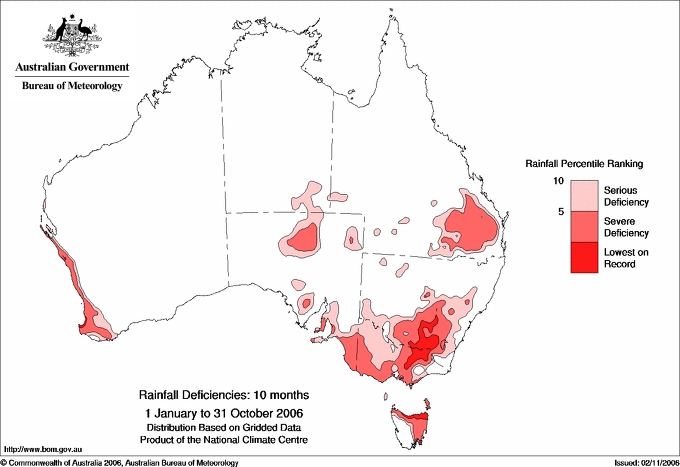 It is worthwhile to look at the Australian Bureau of Meterology website for its discussions of the current drought.
 The map above shows rainfall for the 10 months to 30 October relative to historical experience. The dark red areas are areas where rainfall over this period is the lowest it has been in the period back to 1900, the fairly dark red areas show areas where rainfall falls in the lowest 5% of recorded levels over this period and the pink areas show areas falling into the lowest 10%. There is a serious drought situation over much of south-east Australia, the south-east corner of Queensland, the coastal strip in south western Western Australia and the north east part of Tasmania. Its a grim picture, particularly for Victoria.
There are other similar figures sjhowing the general drought picture for periods going back from 3 months to 3 years here.
The following shows the Bureau's estimated probabilities of rainfall exceeding median rainfall over the next 3 months. A figure less than 50% shows that there is more likely than not to be less than median rainfall.
 For the most part these figures - based for the most part on trends in ocean temperatures - are not very encouraging. The worst drought affected parts of Queensland, NSW and Victoria have a relatively poor expectation of short-term drought relief.
Subscribe to:
Posts (Atom)

 Posts
Posts

